How to Choose Dance Floor LED Lighting for Your Event
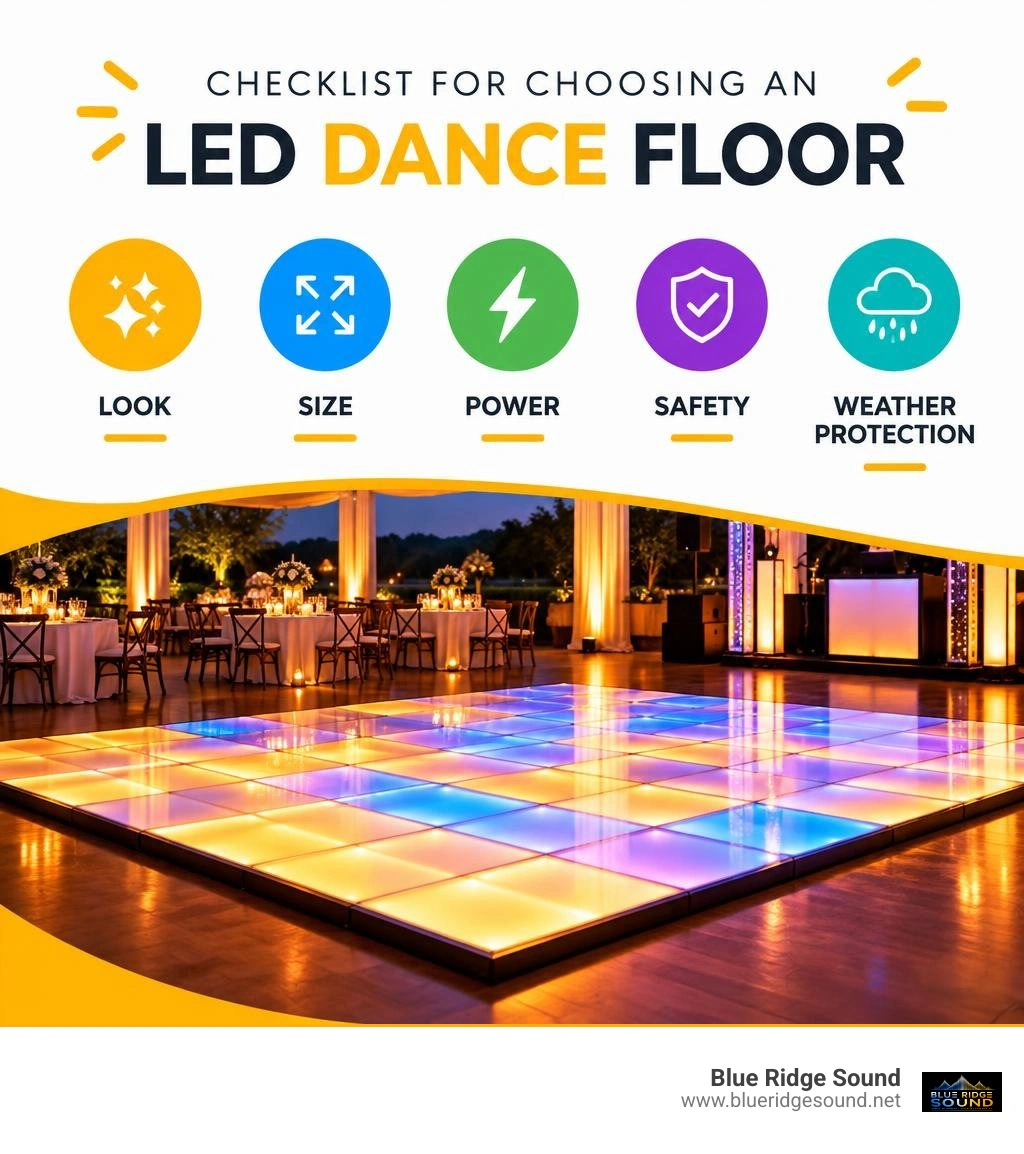
To choose dance floor LED lighting, start by picking the look you want, then check the floor's size, power needs, load rating, and edge ramps with its provider. We have not covered illuminated dance floors elsewhere on our site, so this guide walks through the full decision from style to safety. If your event is outdoors, ask for the floor's documented weather rating and a plan for keeping power connections protected.
For a Central Virginia wedding, also check that your venue has a level space and a safe route for cables. An illuminated floor can draw guests in, while event uplighting can help it feel like part of the room.
I'm Drew Edmondson, owner of Blue Ridge Sound in Charlottesville, where I plan reception DJ, sound, and event lighting for weddings across Central Virginia. That experience shapes my approach to dance floor LED lighting: get the venue details right before choosing the effect.
Why Should You Upgrade to Illuminated Event Floors?
When guests walk into a reception space, their eyes naturally seek out the center of the celebration. An illuminated surface acts as a visual anchor that establishes high energy early in the evening. Pairing floor effects with balanced wedding uplighting transforms the entire room into a cohesive, immersive environment rather than leaving the dance space feeling like an isolated island.
These systems offer distinct advantages for event photography, guest participation, and room atmosphere:
- Distinct Photo Backdrops: The upward ambient glow naturally fills shadows and creates clean, dynamic framing for first dances and parent dances without requiring harsh, direct camera flashes.
- Music Synchronization: Modern setups can transition from a slow, warm amber wash during formal introductions to beat-synced color pulses during high-energy dance sets.
- Spatial Definition: In sprawling barn spaces, rustic estates, or open vineyard tents across Central Virginia, an illuminated floor clearly defines the gathering area without requiring physical barricades or partitions.
- Guest Engagement: Visual cues created by animated chases and subtle color transitions signal shifts in the evening timeline, encouraging guests of all ages to step onto the dance floor.
When considering an installation, verify that the equipment has adequate structural durability and verified load ratings for active crowds, ensuring safe celebrations from the first song to the final send-off. A well-maintained LED floor can also provide dependable service across many events, which is why we inspect panel connections and power routing before every setup.
What Types of Dance Floor LED Lighting Are Available?
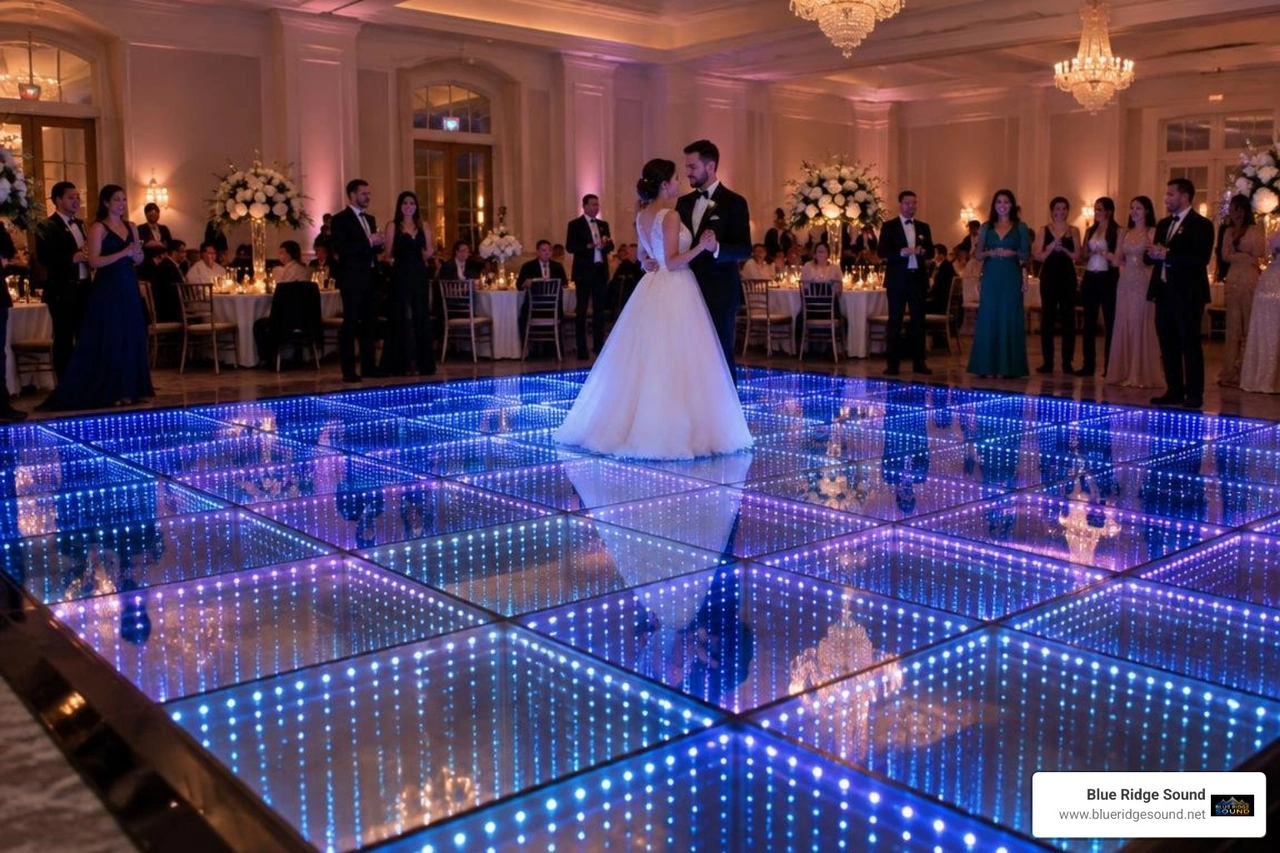
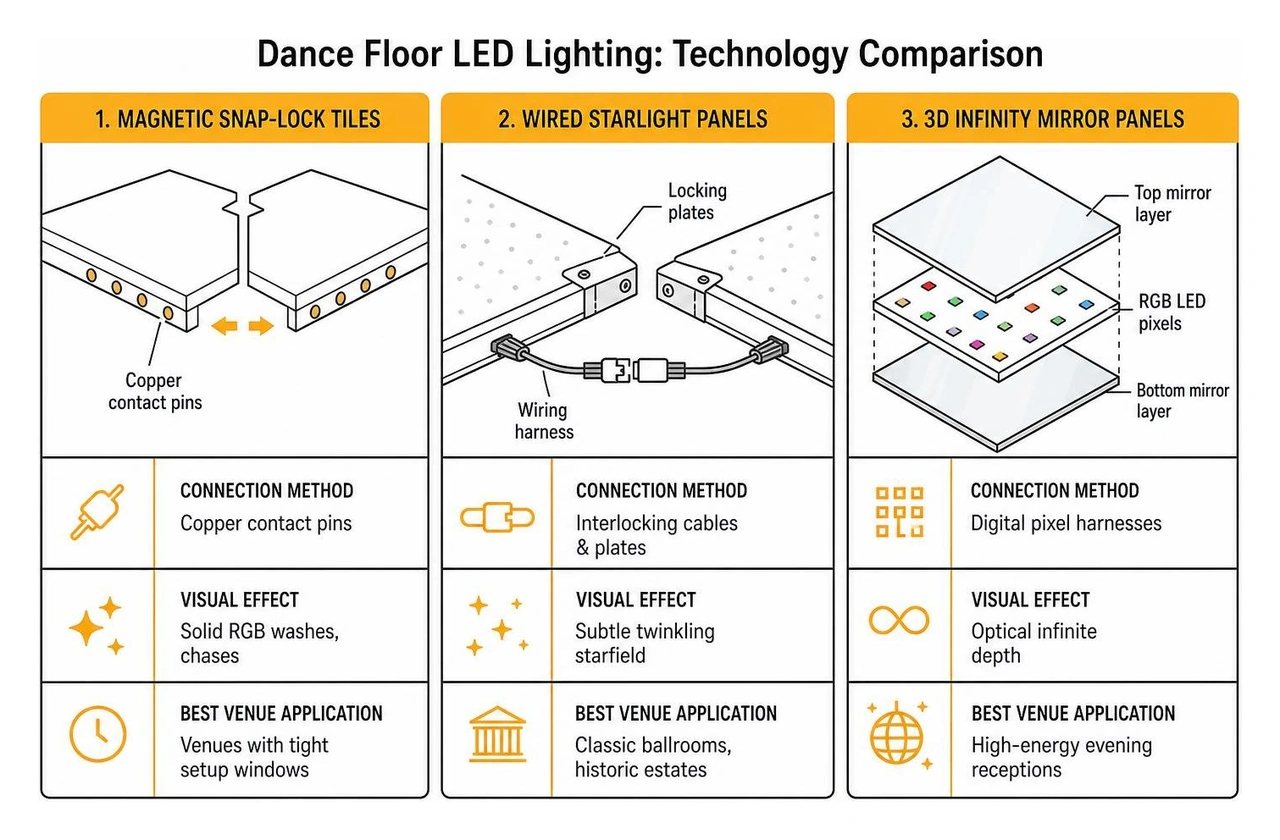
Illuminated floors generally fall into three structural and visual categories, each tailored to specific venue aesthetics and logistical timelines.
| Floor Type | Connection Method | Visual Effect | Best Venue Application |
|---|---|---|---|
| Magnetic Snap-Lock | Copper contact pins | Solid RGB washes, chases | Venues with tight setup windows |
| Wired Starlight Glass | Interlocking cables & plates | Subtle twinkling starfield | Classic ballrooms, historic estates |
| 3D Infinity Mirror | Digital pixel harnesses | Optical infinite depth | High-energy evening receptions |
Magnetic Snap-Lock Tiles
Magnetic modular tiles use embedded copper contact pins that lock together rapidly. Because signal and low-voltage power pass directly through the interlocking edges, technicians can assemble a full layout in a fraction of the time required by traditional cabling. This setup speed makes them ideal for venues in Albemarle County and Crozet with strict vendor load-in windows. They pair smoothly with perimeter event lighting and uplighting for a balanced room aesthetic.
Wired Tempered Glass and Starlight Panels
Wired tempered glass panels rely on dedicated wiring harnesses secured beneath edge locking plates. These systems frequently feature a starlight or "twinkle" effect embedded under frosted or black surfaces. They offer a refined, timeless look that fits traditional Virginia vineyard celebrations where a subtle, elegant glow is preferred over rapid color changes.
3D Infinity Mirror and Digital Pixel Floors
Infinity mirror panels place high-output RGB diodes between two specialized reflective layers to produce an illusion of three-dimensional depth beneath your feet. These digital pixel floors allow individual diode control, enabling custom geometric chases, color gradients, and nightclub-style visual impact that energizes evening dance parties.
How Do You Select the Best Technical Specifications?
Choosing the right system involves understanding basic electrical demands, panel sizing, and physical limits to protect your venue's infrastructure. Following event lighting design fundamentals ensures your technical choices enhance the room without overloading circuits or causing logistical delays.
Key Technical Specs for Dance Floor LED Lighting
- Panel Dimensions: Most modular units measure roughly 50x50 cm or 1x1 meter square tiles, allowing flexible square or rectangular footprints tailored to room layouts.
- Surface Construction: Look for double-layer tempered glass (often 10mm thick) or robust ABS composites designed for scratch resistance and impact absorption.
- Electrical Consumption: Typical solid-state LED panels draw relatively low power—often 12W to 20W per tile—keeping overall energy demands manageable on standard venue circuits.
- Viewing Angle and Safety: Broad 120-degree viewing angles ensure even color distribution across the room without harsh glare, meeting photobiological safety practices outlined by standards organizations like the Audio Engineering Society.
Outdoor Weatherproofing and Load Capacities
If your celebration takes place under an open-air pavilion, patio, or tent in the Shenandoah Valley, moisture protection is non-negotiable. Always check documented Ingress Protection (IP) ratings provided in official manufacturer documentation, such as JBL Professional or Bose Professional production standards. Standard indoor units often carry basic dust protection, while outdoor-capable designs require sealed IP55 or IP65 enclosures to resist ambient dampness, condensation, and accidental drink spills. Furthermore, verified structural ratings should comfortably handle heavy dynamic loads across every square meter.
Sizing and Guest Capacity Planning
A practical rule of thumb for wedding planning is sizing the floor for roughly 30% to 50% of your total guest list likely to be dancing at any given moment. Each dancing couple needs enough room to move comfortably without bumping into nearby tables or other dancers. Be sure to account for sloped, non-slip aluminum or ABS perimeter transition ramps, which eliminate tripping hazards where the raised panel height meets the venue floor. During a site visit, we measure the available footprint and recommend a layout that fits the room while leaving clear walkways for guests, servers, and catering staff.
How Do Professionals Coordinate the Setup for Your Venue?

Professional event teams handle the heavy lifting, power distribution, and testing so you never have to worry about technical hurdles on your wedding day.
What Should Be Considered for Layout and Power?
Layout planning begins with assessing the subfloor. An illuminated floor requires a flat, firm surface to prevent panels from uncoupling or rocking under foot traffic. Technicians route power from dedicated circuits, following commercial safety standards such as NFPA 70 National Electrical Code guidelines for temporary event wiring, and securely lock perimeter bevels into place with industrial ramp channels that conceal outgoing cabling.
What Control and Programming Options Are Available?
Professional setups integrate control hardware that lets your operator adjust the floor's mood throughout the timeline:
- DMX512 Control: Standard lighting protocol integration, detailed in our DMX uplighting planning guide, allows your lighting operator or DJ to synchronize the floor's color palette with the overhead rig and room uplights.
- Standalone SD Controllers: Pre-programmed memory cards store dozens of geometric chases, solid color scenes, and smooth fades for simple standalone playback.
- Sound-Active Mode: Built-in microphones or direct audio feeds trigger real-time lighting pulses to match the bassline of your favorite tracks.
How Do You Maintain Floor Safety and Surface Care Throughout the Event?
Keeping an illuminated dance floor looking sharp and performing safely requires ongoing attention before, during, and after the reception. High-traffic dance sets subject floor panels to heel impacts, spilled drinks, and friction from footwear, making practical maintenance essential.
Protecting Floor Surfaces and Cleanliness
Before guests arrive, technicians wipe down all panels using non-abrasive, residue-free glass or acrylic cleaners. This removes smudges and fingerprints left during installation so the surface delivers crystal-clear light transmission. During the party, having quick-absorbent microfiber towels on hand allows event staff to immediately dry any beverage spills, preserving both optical clarity and slip resistance.
Cable Management and Edge Ramp Security
All power feeds and signal interconnects should exit through dedicated corner blocks and run underneath heavy-duty rubber cable ramps whenever crossing footpaths. Inspecting edge bevels periodically throughout the evening ensures transition ramps remain firmly locked to outer tiles, protecting guests in heels and providing smooth accessibility for all attendees.
Frequently Asked Questions About Event Dance Floors
Can LED dance floors support heavy dancing?
Yes, high-grade modular event tiles are engineered with heavy-duty internal supports and thick tempered glass designed to handle active crowds, jumping, and high-impact dancing without cracking or shifting.
Are illuminated floor tiles suitable for outdoor tents and patios?
They can be used in outdoor tented spaces provided the surface underneath is completely flat, dry, and level (such as over a subfloor). Outdoor use requires verified moisture-resistant enclosures and protected electrical distribution to guard against humidity and ground dampness.
Will mirror and glass surfaces reflect guest clothing awkwardly?
High-end event floors use specialized anti-reflective, frosted, or diffused top layers that scatter light evenly. These matte and semi-opaque finishes eliminate sharp mirror reflections while maintaining vibrant color projection.
Ready to plan your wedding sound, reception DJ, or event lighting? Request a personalized quote to start designing your celebration.