Start With the Right Professional Sound for Events
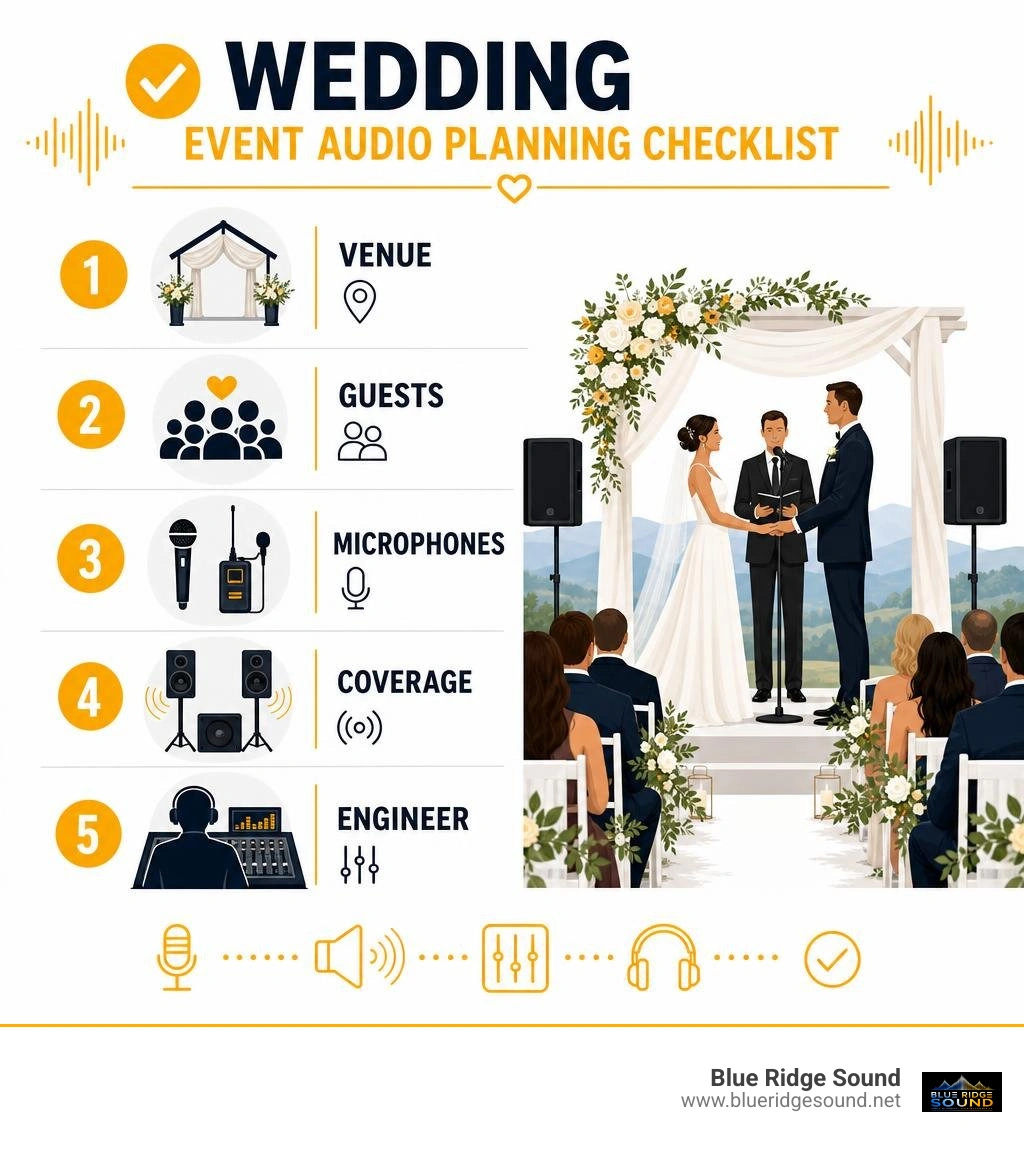
For professional sound for events, start by matching the system to the venue, guest count, and program. For a wedding, that usually means clear speech coverage for the ceremony and toasts, wireless microphones for the officiant and speakers, properly placed speakers, and an engineer to manage music cues and levels.
Before booking, give your sound provider:
- Venue layout, including indoor and outdoor spaces
- Guest count and event schedule
- Music plans, such as a DJ, band, playlist, or ceremony musicians
- Microphone needs for the officiant, vows, speeches, and performers
- Venue rules for power, setup times, and noise limits
Great event audio is not simply about louder speakers. It is about even coverage, speech that stays easy to understand, music that feels full without overwhelming conversation, and backup gear for critical moments.
For couples planning in Central Virginia, early planning helps the audio team account for room echo, outdoor wind, nearby noise, and the handoff between ceremony, cocktail hour, and reception. The goal is simple: every guest hears the moments that matter, while you never have to think about the mixer.
Blue Ridge Sound provides event sound in Charlottesville, VA, and across Central Virginia, including Albemarle County, Crozet, Waynesboro, Staunton, Harrisonburg, Ruckersville, Scottsville, and the Shenandoah Valley. We help engaged couples, wedding planners, venue coordinators, and corporate event organizers with professional JBL and Bose PA systems and full setup-to-teardown service. Services include wedding ceremony sound, reception DJ and MC services and sound, corporate event sound and audiovisual support, live band support, event lighting and uplighting, and no-power solutions for barns, vineyards, and outdoor venues.
Choosing Professional Sound for Your Venue and Guest Count
You do not need to learn audio engineering to plan clear event sound; your provider should match the speakers to your venue and guest layout. Sound reinforcement is not about turning up the volume until the people in the back can hear. Your provider should plan comfortable listening levels throughout the space and leave enough spare system capacity for louder musical moments without distortion.
When evaluating audio equipment rental options, ask how the provider will match the speakers to your room, outdoor areas, and guest seating. Sound gets quieter over distance and interacts with walls, ceilings, and floors. A system that is too small can sound strained when turned up. Ask your provider to plan for both clear speeches and the louder demands of your DJ or band.

Speaker Options for Smaller Rooms and Larger Outdoor Events
Point-source speakers are individual speaker cabinets; line arrays use a vertical group of speaker cabinets to help control coverage. Your provider should choose between them based on the space and how far back guests will be seated.
Individual speakers can cover many ceremony and reception spaces when positioned to reach the guest seating. According to the inverse-square law, sound from an ideal point source in an open space drops by about 6 decibels—a measure of sound level—each time the distance doubles. In practice, this means the back rows need attention during speaker placement. Point-source systems from manufacturers such as JBL and Bose can suit small to mid-sized venues; 50 to 500 guests is an illustrative range, not a capacity guarantee. With suitable placement, they can provide clear speech across the seating area at wedding receptions, corporate meetings, and galas.
For a large outdoor event or a deep seating area, your provider may recommend a line array. Its vertically grouped speakers help control where sound travels. Ask how the proposed layout will keep speech clear at the back without making the front rows uncomfortably loud.
| Feature | Point Source Systems | Line Array Systems |
|---|---|---|
| Coverage approach | Individual cabinets with coverage shaped by their design | Vertically grouped speakers that help control coverage |
| Sound-level drop with distance | About 6 decibels per doubling in ideal open-space conditions | Can approach 3 decibels per doubling over part of the coverage area; depends on array design |
| Illustrative Audience Capacity | 50 – 500 guests | 300 – 5,000+ guests |
| Illustrative Coverage Distance | 10 – 30 meters | 40 – 80+ meters |
| Ideal Event Applications | Weddings, corporate galas, private parties, indoor clubs | Larger outdoor events and deeper audience areas |
| Rigging & Setup Footprint | Often uses floor stands or speaker poles, with less installation work | May need overhead supports, specialist installation, and computer coverage planning |
Decibels measure sound level. The audience capacities and distances above are illustrative, not specifications for every system; actual coverage depends on the system and venue.
Keeping Bass Clear and Comfortable
Bass can spread beyond the dance floor and make speech harder to hear. Ask your provider how they will position the bass speakers to keep music full without overwhelming speeches or conversation.
For some events, a provider may arrange subwoofers—the speakers that handle deep bass—to send less bass toward the stage or neighboring areas. Tell them where musicians, dining tables, and nearby properties will be so they can plan the placement.
Microphones, Mixing, and Support for Performers
Your engineer checks the full path from each microphone or instrument to the speakers. They set levels to keep speech and music clear while leaving room for louder moments. When arranging live sound production services, share the event schedule and performer requirements early so the team can plan connections, sound checks, and transitions.
How the Engineer Connects and Controls Your Audio
Digital mixing desks let the engineer adjust each microphone and instrument separately, shaping tone and controlling sudden changes in volume. For planners, the useful question is who will manage those adjustments during speeches, music, and transitions.
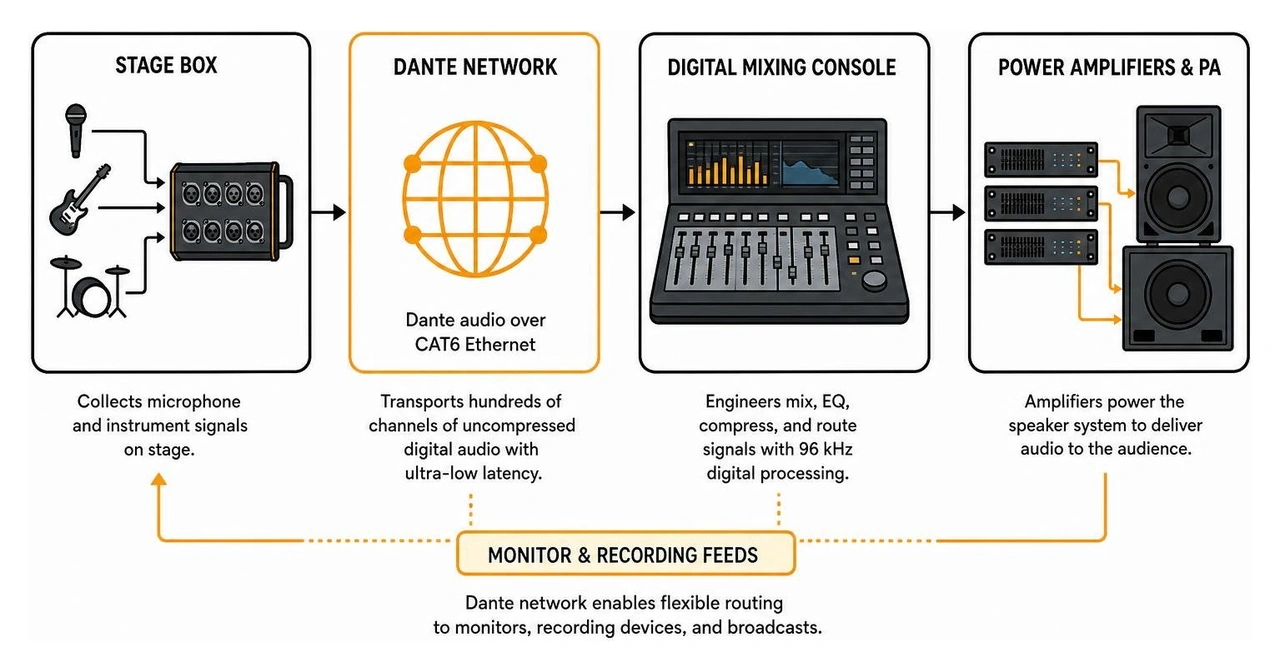
Some event systems use Dante, a digital network that carries audio between equipment over Ethernet cables. It can connect microphones near the stage to the front-of-house mixer—the desk used to control what guests hear. Ask your provider how cables will be routed safely around guest walkways.
Planning Reliable Wireless Microphones
Wireless reliability is essential for corporate keynotes, wedding vows, and vocal performances. Dropped audio or static bursts often stem from intermodulation distortion—unwanted phantom frequencies generated when multiple wireless transmitters interact.
Your audio team should check local radio activity and choose compatible wireless microphone frequencies before the event. Tell them how many people need microphones, whether the officiant needs a clip-on mic, and where speakers will stand or move. Ask who will check batteries and keep a spare microphone ready.
Performer Monitoring and Front-of-House Mixing
Clear monitoring helps musicians hear themselves and perform with confidence. Floor monitor speakers help musicians hear themselves, but their sound also reaches the audience and can make the overall mix harder to balance.
In-ear monitors are earpieces that let performers hear a personal mix without adding sound from floor monitor speakers. For bands using floor monitor speakers, dedicated live sound engineering includes checking the monitors before guests arrive and reducing frequencies that could cause feedback—the unwanted squeal from a microphone and speaker feeding sound back into each other.
Planning Sound for Echoing Rooms and Outdoor Venues
Every venue presents its own sound challenges. Polished concrete, glass walls, and high ceilings can make speech echo. Your provider may use several speakers closer to guests rather than one loud pair at the front. Share the seating plan so they can aim speakers toward listeners and away from reflective surfaces.

Outdoor Sound Levels and Venue Noise Rules
Outdoor sound planning needs to balance comfortable listening for guests with local noise rules. Wind and changing weather can affect how sound carries. Share your outdoor seating plan and weather backup plan so the team can check coverage and adjust as conditions change.
Ask who will monitor sound levels and which limits apply at the venue and property boundaries. Your provider can plan speaker direction and bass coverage with neighboring properties in mind; tell them about any nearby homes and the venue’s music cutoff time.
Coordinating Sound, Lighting, Video, and Power
Audio equipment needs a reliable power supply. Ask the venue and audio provider to confirm which outlets and circuits are available, especially when lighting and catering equipment also need power. For a barn, vineyard, or outdoor ceremony without outlets, discuss the power plan before booking.
When sound, lighting, and video are planned together, the teams can coordinate equipment placement, cables, and cues. Choosing comprehensive event audio visual rental integration gives you a chance to confirm who is responsible for power safety, equipment supports, and keeping guests’ views clear.
Production Logistics, Contingency Planning, and Booking Workflows
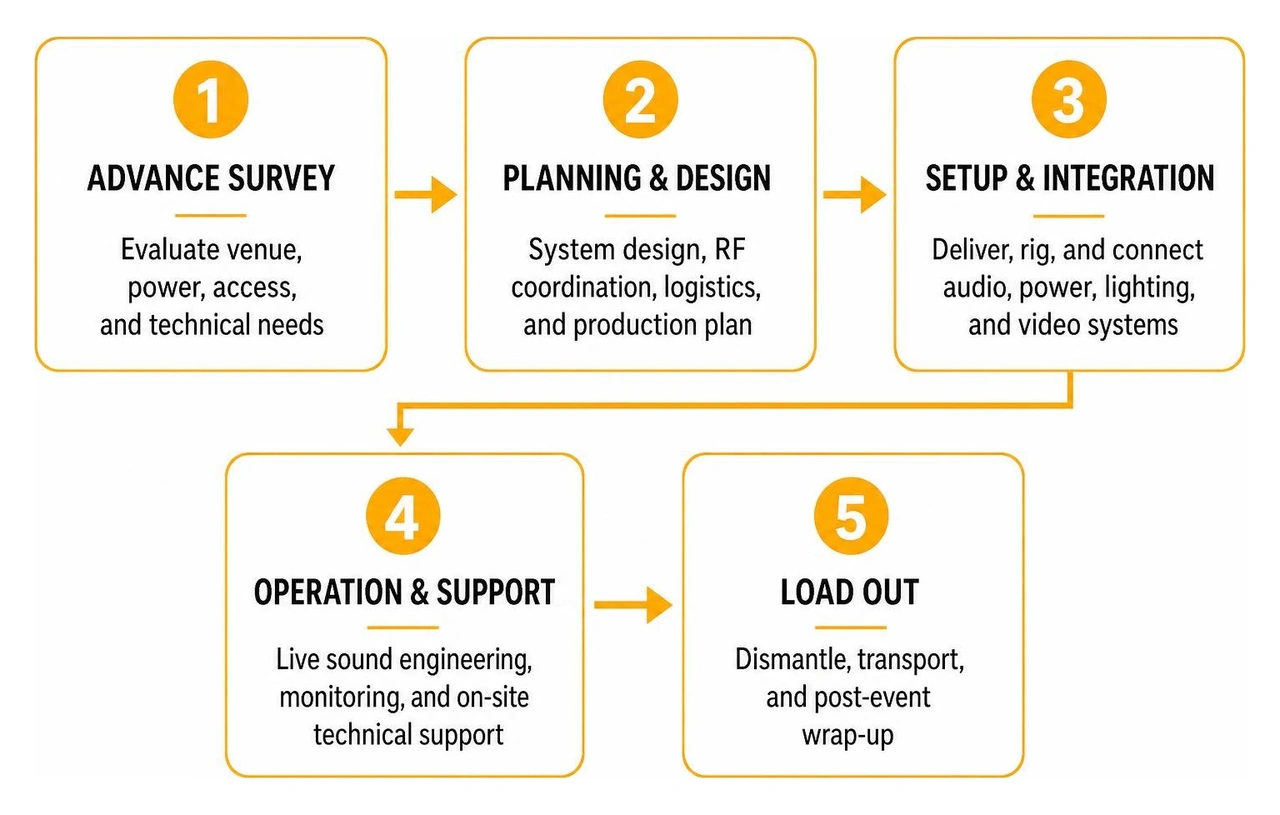
Reliable event sound starts with planning before the day. Agree on arrival times, sound checks, key cues, and backup equipment so everyone knows what to expect.
Budgeting and Timeline Planning for Professional Sound for Events
Your audio quote depends on the equipment, guest count, venue layout, and staff needed. Small speech packages might begin near $500, while comprehensive wedding and corporate audio productions may range from $1,200 to $3,000. Treat these as planning examples, not a quote for your event, and ask what setup, staffing, and teardown are included.
Booking your audio production 2 to 3 months in advance for weddings and major corporate conferences—and 4 to 8 weeks ahead for smaller gatherings—can improve your chances of securing your preferred provider, but confirm availability before making plans around it. For gatherings that need sound tailored to the venue, securing a comprehensive PA system rental with professional delivery, setup, and a sound check helps the team prepare for your venue.
Technical Rider Coordination and Custom Quoting
For live bands and touring artists, a technical rider is a document outlining their production needs. It lists microphone and instrument connections, shows where performers and equipment will sit, explains what each musician needs to hear, and gives power requirements. Ask your band to send it to the audio provider before the event.
When preparing your event, requesting a custom event quote with your venue layout, event schedule, and any band equipment requirements helps our team plan sound for your space and key moments.
Frequently Asked Questions About Event Sound
Do I need an on-site audio engineer for my event?
For events with speeches, wireless microphones, or live music, an on-site engineer can be valuable. They adjust speech and music levels, check wireless microphones, and respond to feedback or changes in the room as guests arrive. Ask your provider what on-site support fits your program and who will handle troubleshooting.
How do professional sound systems handle weather and wind at outdoor events?
Ask your provider what weather protection their equipment needs and when conditions would require moving indoors or stopping. Wind can affect how sound carries, so the team should check speech clarity across the seating area. Confirm a rain plan and sheltered equipment locations with the venue before the event.
What backup equipment is essential to prevent live audio failure?
Ask which backups are included for your event and how quickly they can be put into use. Useful items to discuss include spare microphones and batteries, replacement cables, and a backup music source. The provider should explain the plan for a speaker, mixer, or power problem during a key moment.
Take the Next Step Toward Clear Event Sound
You do not need to manage the audio details yourself. Share your venue, guest count, schedule, and music plans with an experienced provider so they can prepare for speeches, announcements, and the dance floor. For events featuring live musical performances, pairing your production with professional live band sound support helps coordinate what the musicians hear on stage with what your guests hear throughout the venue. Ready to plan your event sound? Request a quote at blueridgesound.net or call (434) 872-1893.