Dance Floor Lighting Sets the Mood for Every Wedding Moment
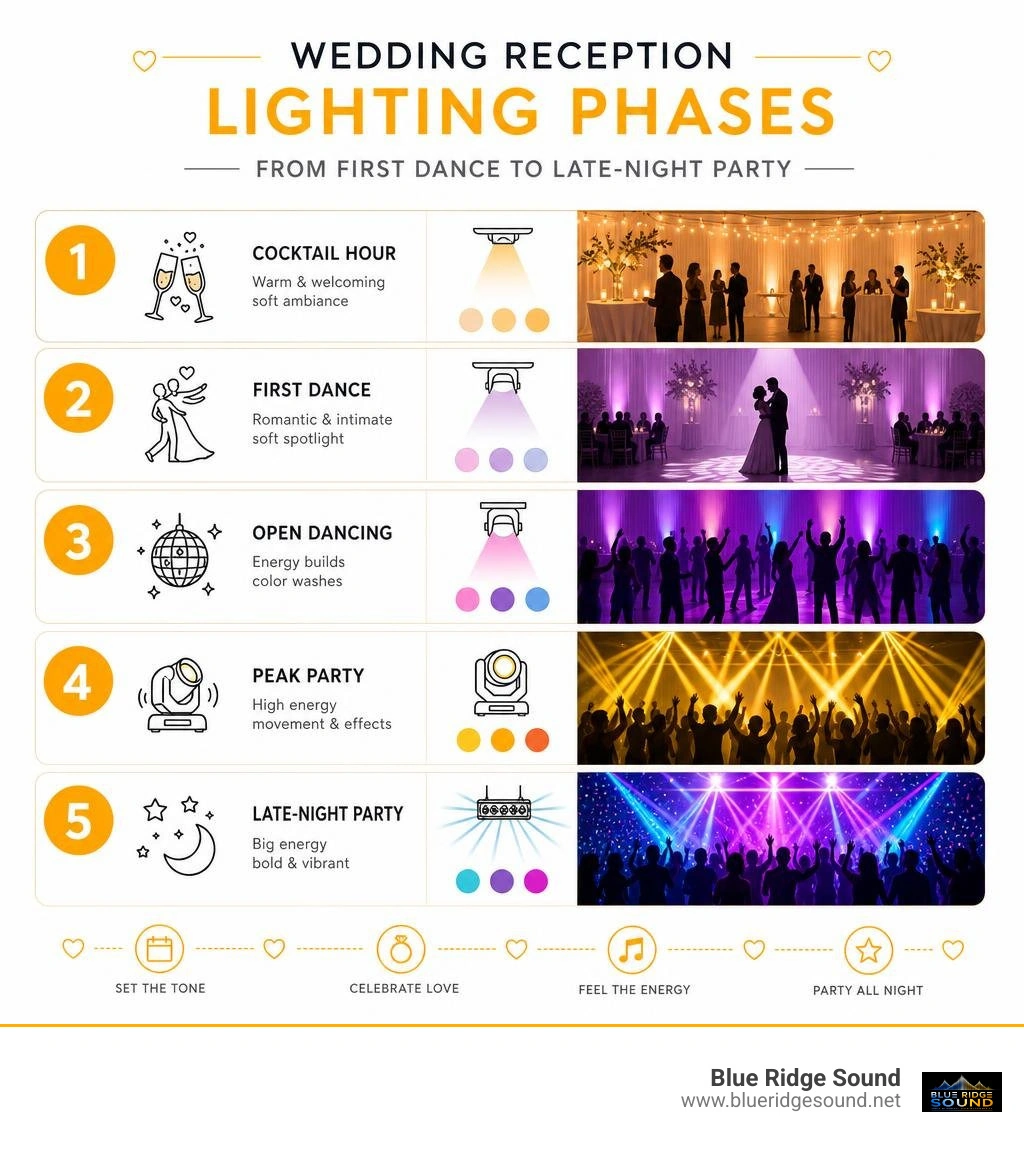
The best dance floor lighting for a wedding uses gentle, flattering light for dinner and the first dance, then shifts into brighter color and movement once open dancing begins. Start with a warm or soft white wash, add uplighting in your wedding colors, and use a custom monogram or subtle spotlight for key moments. Save fast strobes, bold beams, and high-energy effects for the late-night party.
Lighting does more than make photos look better. It helps guests understand the pace of the night without anyone needing to announce it. Soft pinks, purples, blues, and warm whites can feel romantic and relaxed. Richer colors, moving lights, and music-synced effects can make the same space feel like a full dance party.
For a Central Virginia wedding, the right plan should fit your venue, power access, ceiling height, dance floor size, and guest comfort. A lighting setup should feel intentional, not so bright or busy that it overwhelms the room.
Core Types of Dance Floor Lighting for Modern Events
You don't need to know every lighting model to plan a beautiful reception. Start by telling your DJ how you want dinner, formal dances, and open dancing to feel; they can recommend a mix of lights for those moments.
Wash Lighting and Ambient Glow
Wash lights spread a broad, even layer of light across the dance floor or room. Ask your provider to show you how your wedding colors will look in the venue, rather than choosing lights by their technical specifications alone.
Wash lights spread light more softly than a narrow spotlight. We can place them around the dance area and adjust their brightness so guests feel comfortable and your photographer has useful light to work with.
We use event lighting design fundamentals to coordinate lights around the room with your venue’s existing lighting. Pairing room washes with targeted event uplighting services can turn plain walls into glowing backdrops that match your wedding colors during dinner and pulse gently when the music builds.
Moving Heads and Dynamic Spotlights
Moving-head lights turn from side to side and up and down, letting your lighting operator direct light around the room. Ask how they will be used for your entrance and formal dances, including whether a steady, soft spotlight is available for those moments.
For open dancing, moving-head lights can add moving patterns, beams, and color changes. Let your DJ know whether you prefer gentle movement or a more energetic party look.
If you're considering concert-style effects such as Kinetic Matrix Strobe Bar fixtures, ask your provider whether they suit your venue, guest comfort, and budget. Specialized overhead effects need a venue-approved installation plan.
Special Effects: Strobes, Gobos, and Lasers
Special effects can add excitement to open dancing, but you don't need every option. Discuss which effects you enjoy and which you would rather avoid:
- Custom Gobos: A gobo is a pattern template used to project a design, such as your monogram or wedding date. Ask where the design will appear and whether it will be easy to see.
- Strobe Effects: Strobes create repeated flashes. Tell your DJ about guest sensitivities and whether you want flashing effects omitted.
- Laser Effects: Lights such as KeoBin 3D RGB laser party lights and the X10 sound-activated DJ laser light offer patterned effects. Ask your provider whether lasers are appropriate for your venue and how they will be operated safely.
Choosing the Perfect Lighting Control and Atmosphere Setup
Choosing lights is only the first step. A clear plan for power, placement, and lighting changes helps your reception feel relaxed and well coordinated.
How an LED Dance Floor Lighting System Transforms the Room
An illuminated LED dance floor can make the dancing area a centerpiece of your reception. These floors use connected panels. Ask the rental provider about the finished size, surface material, permitted loads, and installation requirements for your venue.
Depending on your aesthetic preferences, modular dance floors offer several distinct visual styles:
- Starlight / Starlit Panels: Small white lights create a still or gently twinkling, starry look—worth considering for a softer reception style.
- 3D Infinity Floors: Mirrors inside the panels create the appearance of depth beneath your feet. Ask to see a demonstration before choosing this look.
- Pixel-Mapped Video Floors: Individually controlled lights can display changing colors, text, and patterns. Ask which designs are available and who will control them during the reception.
| Dance Floor Feature | Static Starlight LED Floor | Interactive 3D Digital LED Floor |
|---|---|---|
| Primary Aesthetic | Subtle, romantic, classic elegance | Modern, high-energy, immersive |
| Panel Construction | Acrylic / Composite with static LEDs | Tempered glass with mirrored layers |
| Color Capability | Monochromatic (Warm White / Pure White) | Red, green, blue, and white (RGBW) color mixing & video graphics |
| How It's Controlled | Radio-frequency (RF) remote / preset programs | DMX512 lighting control / dedicated computer software |
| Ideal Reception Moments | Dinner, slow dances, classic first dance | Peak open dancing, electronic dance music sets, high-energy party |
| Power Draw | Low (5W–15W per modular panel) | Moderate to High (30W–80W per panel) |
Why Sound-Activated and DMX Dance Floor Lighting Matter
Ask your DJ who will control the lights and how lighting changes will fit your reception timeline. You'll generally hear about three control options:
- Static / Auto Mode: Static settings hold a chosen look; automatic programs cycle through preset changes without following the music.
- Sound-Activated Mode: A microphone in the light triggers changes in response to sound. Ask whether this mode will be switched off during toasts and quieter moments.
- DMX512 Control: DMX512 is a digital control standard that lets an operator send instructions to compatible lights through cables or wireless equipment. Ask who will manage the lighting cues for your entrance, dances, and speeches.
With DMX control, a lighting technician can adjust colors, movement speeds, flashing speeds, and how gradually the lights brighten or dim in real time. We can plan lighting scenes around your wedding timeline: soft amber light during cocktail hour, steady spotlights for your formal dances, and coordinated color changes when the dance floor opens.
For a larger lighting setup, ask your provider how they will route cables safely and check that each light responds correctly; our DMX uplighting addressing and cabling checklist covers those planning details. If they use wireless lighting control, ask about their backup plan for interference, as discussed in our wireless DMX RF fallback planning guide. Our professional audio and lighting terminology guide can explain unfamiliar terms, but you can always describe the look you want in everyday language.
Designing the Right Brightness and Color Palette
The color and brightness of your lights help set the mood. Here are a few looks to discuss with your DJ:
- Warm Tones (Amber / Soft Pink): A gentle option for an intimate, welcoming dinner setting. Warm white light is often described as 2700K–3200K; K means kelvin, the scale used to describe how warm or cool white light looks.
- Cool Tones (Blue / Cyan / Lavender): Consider these colors for a relaxed, modern look during cocktail hour. Ask to see how they look in your room.
- Saturated Tones (Red / Green / UV Purple): These create a bold, lively look for upbeat dance sets. Ask your provider to demonstrate the effect before choosing it.
You don't need full brightness all evening. Ask your DJ to adjust the lighting for dinner, formal dances, and open dancing, keeping guest comfort in mind. General room lighting at roughly 15–25% brightness can be a starting point to discuss, rather than a fixed target for every venue. Focused lights can highlight the dance floor while your provider checks that guests can still move around safely.
Key Logistics, Safety, and Budgeting Considerations
Before booking, confirm who will handle safe power connections, secure mounting for overhead lights, and the full cost of setup and operation.
Power Distribution and Rigging Safety
Too many powerful lights on one electrical circuit can trip a breaker during your reception. Ask your provider to check the venue’s available power, including which 15-amp or 20-amp circuits are suitable for the equipment, spread equipment across suitable circuits, and check for speaker hum caused by lighting controls before guests arrive.
When your provider mounts overhead lights on tripod stands or truss systems—the support frameworks used to hold overhead lights—confirm these safety details:
- Ask your provider to confirm that each tripod stand has wide, locking legs and a rated capacity suitable for the lights and their mounting height.
- Every overhead fixture must be secured to the lighting bar or truss with a rated steel safety cable alongside its primary mounting clamp.
- All power and DMX lighting-control cables brought down to floor level must be organized neatly, routed away from main walkways, and secured with professional cable-securing tape or protected by rubber cable ramps.
Atmospheric Effects and Venue Guidelines
Haze adds tiny particles to the air that scatter light, making the path of a beam visible. If you want that look, ask your venue whether haze is allowed before adding it to your lighting plan.
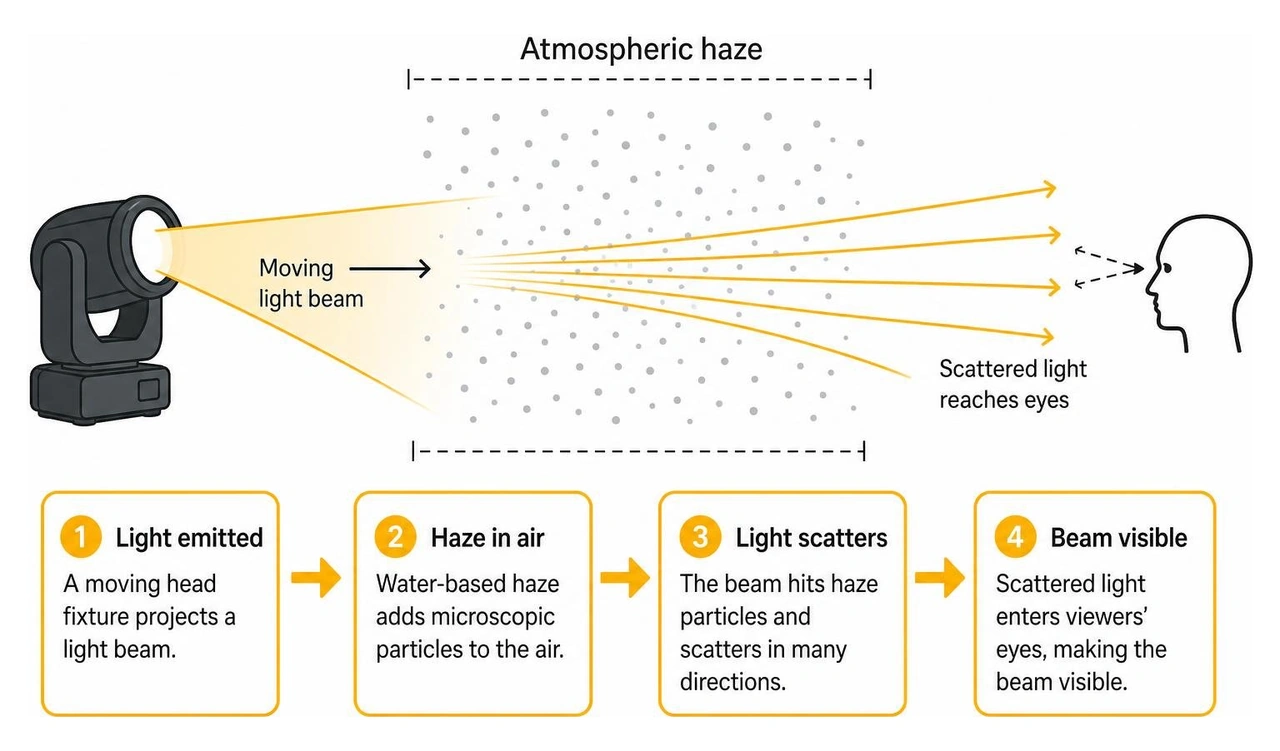
Water-based haze machines produce a fine mist rather than the dense clouds associated with theatrical smoke machines. Before booking one, confirm that your venue permits haze and ask the venue team about its alarm system. Haze can trigger smoke detection systems, including optical beam smoke alarms, which detect changes in a beam of light. Get venue approval well ahead of your event date.
Rental vs. Purchase Cost Realities
Investing in professional lighting involves balancing equipment costs, transportation, programming time, and on-site operation:
- Buying Equipment: For a one-day celebration, compare the full cost of buying lights with a managed rental. Buying also leaves you responsible for transport, cables, programming, safe installation, and packing everything away.
- Managed Production Rentals: An experienced audiovisual provider can supply maintained equipment along with venue-specific delivery, setup, live operation, and teardown. Ask which services are included in your quote.
Booking custom wedding DJ lighting packages or reserving comprehensive dance floor lighting rentals ensures that your lighting is appropriately sized, safely rigged, and synchronized with your sound system under a single, transparent contract.
Frequently Asked Questions About Event Lighting
How much lighting is needed for a standard reception venue?
The right amount of lighting depends on your venue's size, ceiling height, how much light its walls reflect, and guest count. For a reception of 100 to 200 guests with a 20x20 foot dance floor (400 sq ft), discuss these starting points with your provider:
- Wash Coverage: Two to four broad wash lights may be a starting point, but ask your provider to confirm coverage for your room. If you're comparing options such as the PULSARIS 960B II, focus on a demonstration of the coverage and brightness rather than the model's specifications.
- Moving Lights: Discuss whether two to four moving-head lights would suit your space. If the plan calls for mounting them 8 to 12 feet high, have your provider confirm safe mounting and venue clearance.
- Perimeter Uplighting: Twelve to twenty wireless uplights spaced 6 to 10 feet apart along the walls can be a starting layout. Ask your provider to adjust the number and spacing to your room.
Can dance floor fixtures and LED panels be installed outdoors?
Yes, if the equipment is suitable for outdoor use and your provider has a weather-protection plan. Some LED wash lights have an IP65 rating, meaning protection against dust and water jets—not immersion. Check each fixture's rating rather than assuming it is weatherproof; modular LED dance floors and moving-head lights contain sensitive electronics and may need additional protection.
For outdoor installations:
- Modular LED dance floors must be set on a firm, completely flat, moisture-sealed subfloor rather than directly on grass, gravel, or dirt.
- All outdoor lighting rigs must be placed under waterproof tents or covered pavilions.
- Heavy-duty ground stakes or sandbags must secure lighting tripod bases against unexpected wind gusts.
Is a haze machine required to see moving light beams?
A haze machine is not strictly required, but it significantly elevates the visual impact of your lighting. Without atmospheric haze, guests will only see the pool of light where the beam hits the floor, walls, or ceiling. With light, water-based haze suspended in the air, the entire beam path becomes visible, creating dramatic light tunnels, overhead cones, and crisp aerial effects. In venues where haze is restricted, we adjust our lighting design to emphasize textured gobo patterns across surfaces, vibrant perimeter uplighting, and color washes.
Professional Sound and Visual Production with Blue Ridge Sound
Blue Ridge Sound is a Charlottesville, VA event sound business serving Central Virginia, including Albemarle County, Crozet, Waynesboro, Staunton, Harrisonburg, Ruckersville, Scottsville, and the Shenandoah Valley. We help couples, wedding planners, venue coordinators, and corporate event organizers with wedding ceremony sound, reception DJ and MC services, corporate event sound and audiovisual support, live band support, lighting and uplighting, and no-power solutions for barns, vineyards, and outdoor venues. Our professional JBL and Bose PA systems—speakers and equipment that amplify speech and music—come with full setup-to-teardown service.
We pair professional JBL and Bose sound systems with operator-controlled DMX lighting to help your reception flow from a relaxed dinner into open dancing. Our clear, all-inclusive proposals account for how sound carries through your venue and where lights will work best.
Ready to bring your wedding vision to life with custom lighting and music? Explore our wedding DJ and entertainment services, then request a quote at blueridgesound.net or call (434) 872-1893 to discuss your wedding plans.